
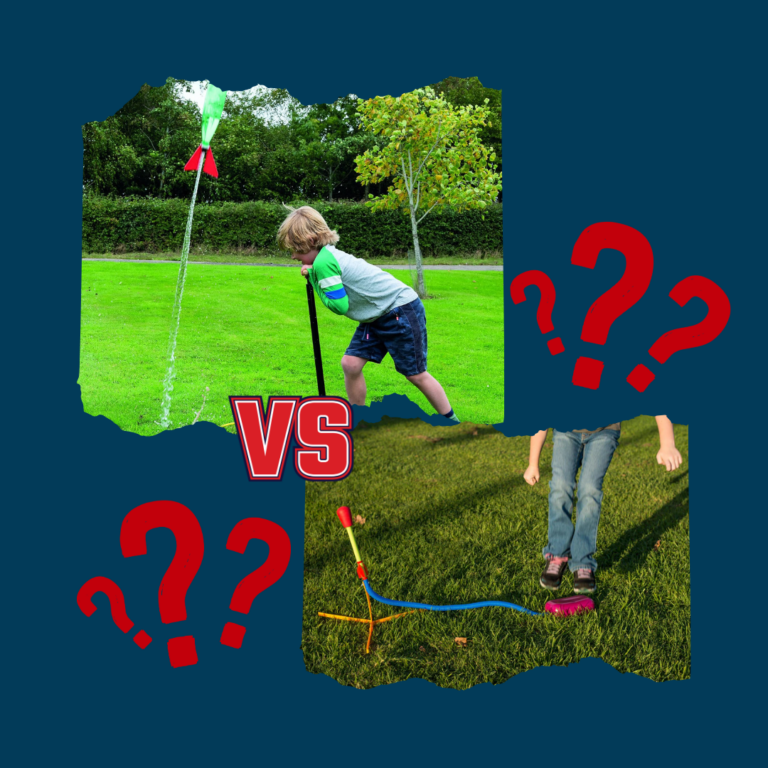
As a science and technology educator, you are constantly searching for innovative ways to ignite curiosity in your students. Water rockets and air rockets present two exciting avenues to explore fundamental principles of physics, aerodynamics, and engineering right in your classroom. But which one is better for educational purposes? Let’s launch into the world of rockets and find out!
Before we jump into the finer points of each type, let’s clarify what we mean by water rockets and air rockets.
Water rockets utilise the power of water and air pressure to generate thrust. These rockets typically consist of a recycled plastic bottle filled partially with water, which means they are not only exciting but also environmentally friendly! As you pressurise the air in the bottle, the water gets forcefully expelled through a nozzle when released, launching the rocket skyward.
Air rockets, on the other hand, rely solely on air pressure without the added element of water. Often made from lightweight materials, these rockets can be propelled by air released from a pump or a simple launch mechanism. They’re generally faster to set up but may offer a slightly less dramatic launch experience compared to their water-filled counterparts.
Water rockets are particularly engaging for students. The sound of the launch and the sight of the rocket soaring into the sky often draw spontaneous cheers and laughter from students. This sense of adventure can create a learning environment ripe for exploring physics concepts.
For instance, students can experiment with different amounts of water to observe how it affects the rocket’s height. Such practical hands-on experience transforms abstract theories into tangible learning moments that foster curiosity and critical thinking.
Another compelling reason to consider water rockets in your curriculum is the ability to incorporate recycling and reuse. You can use everyday plastic bottles, making these rockets both budget-friendly and sustainable!
This not only piques students’ interest in engineering principles but also instils environmentally conscious behaviours. Students will learn that science can be both fun and eco-friendly. How about that for a curriculum boost?
Water rockets can cover numerous topics within the science curriculum, from Newton’s laws of motion to concepts of aerodynamics and environmental science. For instance, you could create a lesson plan about air pressure and forces, challenging students to calculate the optimal water-to-air ratio for maximum height. To help you get started, you can explore our Learning Zone for free lesson plans and educational resources!
Air rockets can be appealing due to their simplicity. They often require fewer materials, making them easier to set up and manage, especially for classes with limited resources.
With fewer moving parts and needing no water, air rockets are sometimes less messy than their water-filled friends. This might be advantageous when managing a large group of excited children ready for launch!
The quick launch process can maintain students’ attention. Air rockets can be launched repeatedly within a short time, allowing for multiple attempts where students can compare data on height and distance. The adventure of launching can lead to robust discussions and exploration of scientific principles!
After considering both types of rockets, it’s evident that neither is objectively better; rather, it depends on the educational goals you have set for your classroom. However, when aiming to enhance engagement and possess a resource-efficient method that cultivates curiosity and hands-on learning, water rockets steal the spotlight.
Combining both types of rockets can provide a well-rounded educational experience. You could start with air rockets to introduce fundamental concepts and, once students grasp these ideas, transition into water rockets for deeper exploration. This gradual approach encourages sequential learning and ensures students can connect theory with practice effectively.
For both water rockets and air rockets, you can engage your students in a practical experiment to determine how different water levels (in water rockets) or air pressure (in air rockets) affect performance. Have students launch rockets with varying amounts of water or air pressure and chart their results.
Find out more in our Water to Air Ratio Experiment.
Explore how different nose cone shapes affect the stability and flight distance of rockets. This practical application of design thinking will allow students to express their creativity while learning essential engineering principles.
Find out more in our Streamline your Water Rocket Experiment.
Set up a windy day flight challenge with air rockets. Students can launch their rockets in varying wind conditions and discuss the effects of wind resistance on flight patterns, encouraging critical thinking and developing problem-solving skills.
Whether you choose water rockets, air rockets, or a combination of both, incorporating these hands-on projects into the classroom is a wonderful way to inspire curiosity and engage students in the world of science and technology. With careful planning, you can turn every launch into an awe-inspiring adventure of discovery.
So, why wait? It’s time to engage your students in STEM learning with exciting rocket launches. To get started today, order your Water Rokit and prepare for a journey of engineering brilliance and scientific exploration. Let’s make science an unforgettable adventure for our young learners.
Remember, the sky’s no longer the limit — it’s just the beginning!
Contacting us is easy, simply complete the form below.
Standard delivery ships in 2-4 working days.
Please allow up to 4 weeks for international orders to arrive (we are working very hard to reduce this time).
FREE on all orders over £25.00;
£3.95 for orders under £25.00;
