

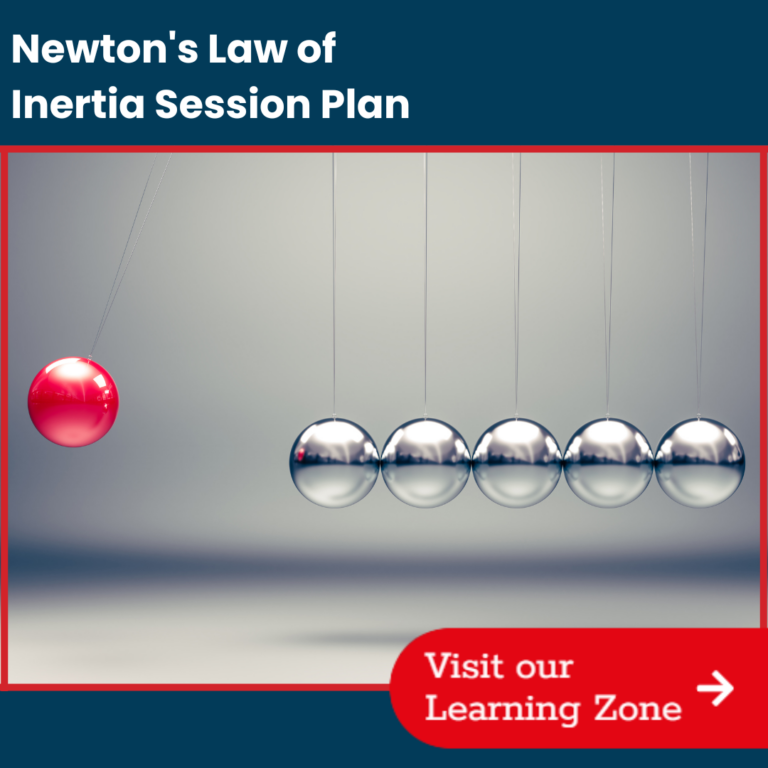
When students hear the word inertia, they often imagine something complicated — but in reality, inertia is one of the simplest and most powerful ideas in physics. Newton’s First Law explains why objects stay still unless pushed, why moving objects keep going unless stopped, and why both principles shape everything from sports to space travel.
Our Newton’s Law of Inertia session turns inertia into an exciting, interactive exploration filled with stories, questions, real-world examples and hands‑on demonstrations. It’s designed specifically for time-poor STEM teachers who want big impact with minimal preparation.
What Our Newton’s Law of Inertia Session Covers
Teachers guide students through two major ideas:
Part 1: How Moving Objects Behave
Students explore motion on Earth vs motion in space. They learn why hockey pucks glide on ice, why objects drift endlessly in a vacuum, and how friction, resistance and force shape the movement of everyday objects.
Part 2: What Inertia Is — and Why Mass Matters
With classroom demonstrations, students compare lifting an empty chair vs a chair with someone sitting in it. They learn that heavier objects have more inertia, making them harder to start, stop or turn.
The session also covers:
- mass vs weight
- why mass stays constant but weight changes
- how inertia applies to seatbelts, ships, bikes and rockets
Hands-on experiments (including water rocket launches) make these concepts memorable and fun.
What Students Will Learn
By the end of the lesson, students can:
- Explain Newton’s First Law clearly
- Understand why objects stay at rest or stay in motion
- Describe inertia and link it to mass
- Predict how objects behave in low-friction environments
- Identify forces acting on real objects (friction, air resistance, gravity)
- Apply the idea of inertia to vehicles, sports, rockets and daily life
This session builds strong scientific literacy, curiosity and reasoning skills.
Curriculum Links
This session supports the core physics learning objectives from:
- KS2 Forces: motion, pushes, pulls, friction, resistance
- KS3 Physics: balanced/unbalanced forces, Newton’s laws, mass and motion
- Working Scientifically: predicting, testing, concluding, questioning
- Cross-curricular: links maths (measurement), PE (sports movement), space science (rocketry)
The content aligns seamlessly with UK STEM curricula, making it easy to integrate into classroom planning.
Real-World Applications Students Immediately Understand
- Why seatbelts stop you from lunging forward in a car
- Why a bowling ball is harder to move than a ping pong ball
- Why massive ships take miles to stop
- Why rockets keep moving in space without engines running
- Why the Moon keeps orbiting Earth
- Why bikes slow down on gravel but not on smooth tarmac
- Why astronauts float in microgravity
Every concept is grounded in practical, relatable experiences.
Benefits for Teachers
- Zero prep needed — clear questions, explanations and examples included
- Flexible delivery — works as a short lesson, full workshop or STEM day session
- Engaging for mixed-ability groups
- Includes hands-on activities and quizzes
- Minimal equipment required
- Integrates perfectly with water rocket outdoor experiments
- Easy to pair with the Newton’s Law of Gravitation session
This session delivers high engagement and high understanding with low workload.
Get the Newton’s Law of Inertia Session Plan from our Learning Zone.