

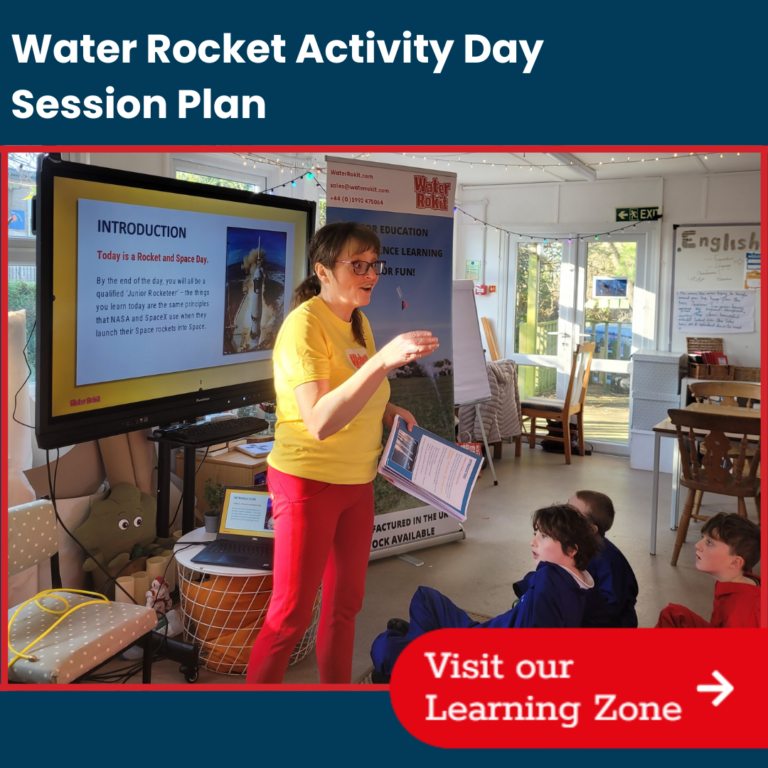
The ultimate hands‑on STEM adventure for ages 8–14, our Water Rocket Activity Day is a high‑energy, full‑immersion STEM experience that transforms your school into a rocket launch site. Students do far more than learn about forces and flight — they build, customise, test and launch their own water-powered rockets. By the end of the day, every learner becomes a certified Junior Rocketeer, proudly holding their achievement certificate and buzzing with excitement.
Designed for time‑poor teachers, this session includes everything you need to run an unforgettable STEM day with minimal prep. Packed with real-world physics, big engineering ideas, and hands‑on activities, it’s perfect for KS2–KS3 and aligns naturally with curriculum learning on forces, motion, friction, stability and scientific investigation.
Whether delivered by you or by the Water Rokit team, this Water Rocket Activity Day consistently delivers a powerful blend of learning, excitement and teamwork.
What the Session Covers
This full-day experience introduces students to the fundamentals of rocket science through accessible, memorable activities:
1. Why Space Rockets Matter
Students discover why rockets are essential for satellites, weather monitoring, GPS, communication, crop tracking, and exploring our solar system.
2. What Satellites Do and How They Orbit Earth
Students explore the role of satellites, how many orbit Earth today, and what they help humanity achieve.
3. Forces: Thrust, Gravity and Newton’s Third Law
Through interactive demonstrations, jumping experiments, balloon rockets and comparisons to squid jet propulsion, students learn what thrust is and how rockets launch.
4. Rocket Stability and Aerodynamics
Pupils explore fins, drag, streamlining and gimbaling. They learn how to keep rockets flying straight—on Earth and in space.
5. Rocket Engineering: Build, Design, Launch
Students construct their own water rocket before heading outdoors for multiple test launches. They experiment with:
- Water levels
- Fins and nose cones
- Drag
- Launch angles
- Payload engineering
6. The Astronaut Egg Experiment
In a brilliant engineering challenge, students must protect their “astronaut egg” through design, testing and impact‑force investigation.
What Students Will Learn
By the end of Activity Day, students can:
- Explain thrust using Newton’s Third Law
- Understand rocket engines, fuel and acceleration
- Explore drag, streamlining and stability
- Test variables (water volume, angle, mass, fins) scientifically
- Predict outcomes and record results
- Build and evaluate their own aerospace designs
- Understand real rocket engineering concepts like gimbaling, boosters and payloads
- Reflect on teamwork, problem solving and resilience
This session teaches physics through doing.
Curriculum Links
Aligned with:
- KS2 Forces: pushes, pulls, friction, resistance, air pressure
- KS2 Working Scientifically: predicting, testing, measuring, evaluating
- KS3 Physics: forces, motion, mass, thrust, stability, pressure
- Engineering and Design: iterative improvement, testing, optimisation
- Maths: measurement, angles, variables
- STEM Careers Education: aerospace, engineering, design, physics
It naturally supports cross-curricular writing, speaking and teamwork outcomes as well.
Real‑World Examples Students Instantly Connect With
- Why rockets need fins
- How the Space Launch System (SLS) produces millions of newtons of thrust
- How satellites help us navigate, communicate, film weather and explore
- Why aeroplanes and rockets must be streamlined
- How real astronauts prepare for missions
- Why payloads matter
- How parachutes reduce descent speed
- How rockets are built, transported and launched (VAB, crawler, boosters)
Students quickly see how classroom science applies to the world’s biggest engineering challenges.
Benefits for Teachers
- Zero prep — everything is scripted, organised and structured
- Easy delivery — run by staff or by the Water Rokit team
- Highly engaging for all learners
- Real science, made simple
- Clear step-by-step activities
- Ideal for STEM days, Enrichment Weeks, Science Week or end‑of‑term events
- Certificate included for each student
This is one of the most exciting and effective ways to deliver physics in primary and secondary schools.
Get the Water Rocket Activity Day Session Plan from our Learning Zone.